Sydney Dance Company’s generous outreach to contemporary choreographers, INDance, opened its second season last night with works from two West Australian choreographers. Founded last year, the venture offers SDC audiences the chance to see a curated program of already existing works by independent Australian dancer-makers. It’s a brilliant idea, although there’s an element of blink and you’ll miss it. Each choreographer, four in total, gets to show their piece three times over three days, either in the first or second weekend.
On any evening it’s possible to see two works, although it’s important to note that the programs are not double bills. Nothing connects the pieces other than their selection for INDance.
Week One features precipice, by the highly experienced Rachel Arianne Ogle, and Cry Baby, by early-career choreographer Kimberley Parkin, working as Parkin Projects. (Ogle’s work Of Dust was part of SDC’s New Breed program of new work in 2016.)
I know I said INDance pieces seen on the same night aren’t meant to be regarded as a double bill but the Ogle-Parkin pairing could be considered an effective one. Ogle’s work is super, super serious; Parkin’s is explosive fun. Let’s put it this way. You wouldn’t want to see them in the reverse order.
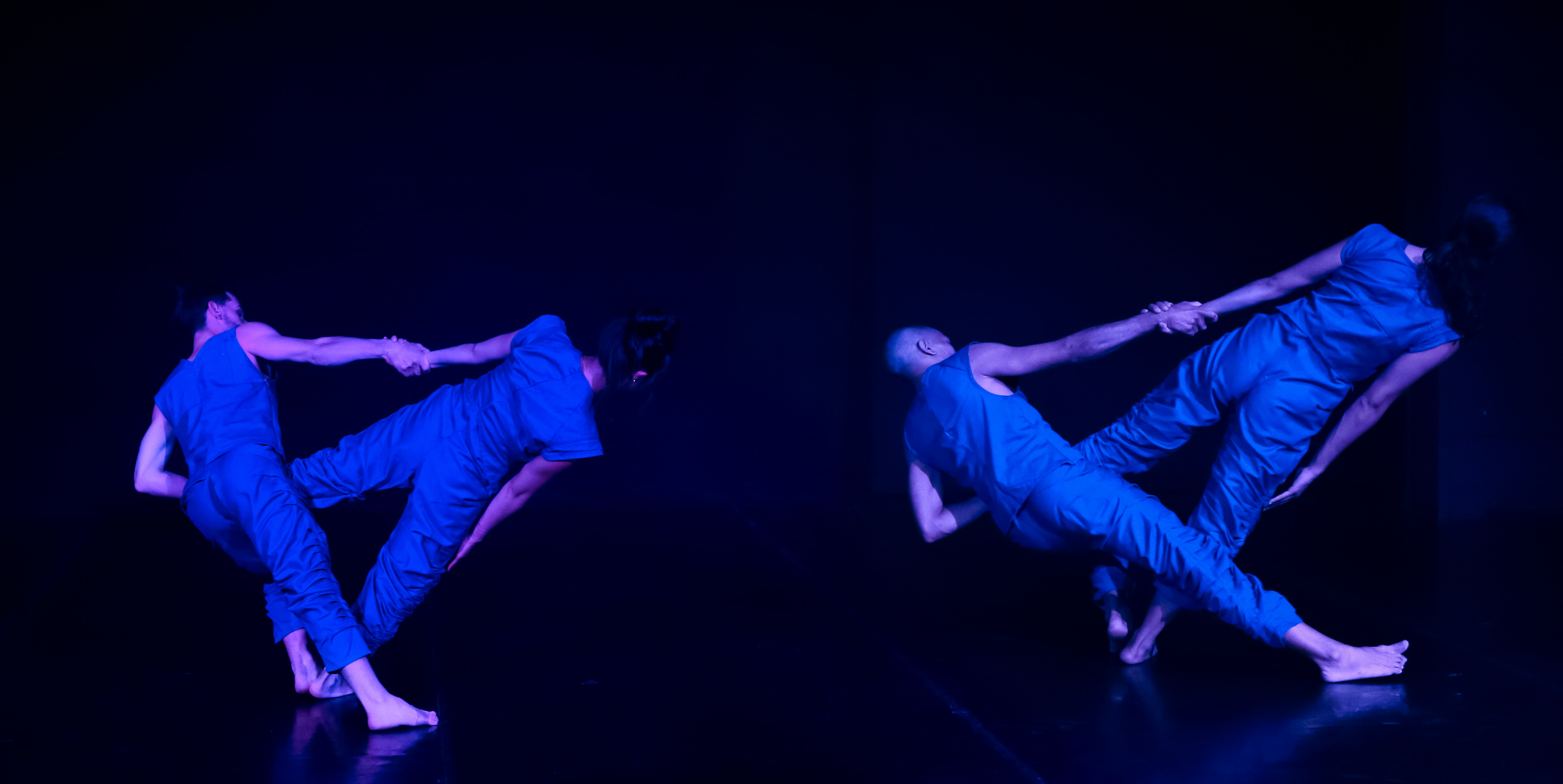
First to precipice (although why the title should have a lower case p is not clear). The work premiered in 2014 and has previously been revived in Perth, so it comes fully formed. It opens in lengthy silence with four dancers each standing at the end of a large cross on the floor. The two women and two men (Storm Helmore, Yilin Kong, Tyrone Robinson, Imanuel Dado) are dressed identically in blue trousers and tops that don’t draw attention to the anatomy. The dancers look sleek and somewhat androgynous and anonymous.
The first section sees dancers approach their opposite number, look intently at them, circle them, and then retreat. For close to 10 minutes the action is repeated again and again, getting faster and faster. Physical contact and small jumps come into play. Eventually the pairs scream in each other’s faces, there’s a huge flash of light, a blackout, Luke Smiles’s electronic score kicks in and a series of more complex interactions between the four begins.
Smiles’s score (lots of white noise, clanks, crackles, static and beeps) and Benjamin Cisterne’s lighting (sometimes aggressive, often gorgeously hazy, always fascinating) are critically important in giving precipice its shape.
Ogle speaks of being inspired by “tectonic shifts, gravitational torsion, states of emotional rupture”. The first two impulses can be seen clearly in the choreography, which has a severe formality. There’s not much evidence of emotion, ruptured or not. The dancers – all splendid – are like well-oiled machines as they work in a movement language heavily directed towards everyday actions. There is walking, running (a lot of running), balancing, weight transfer, shapes from somatic practices and so on, albeit done with an exceptionally high gloss. When hands and bodies come into contact there’s scant intimacy, particularly as the dancers look so impassive. The effect is distancing as precipice looks simultaneously extremely purposeful but somehow aimless. It’s hard to know if that is the intent.
Ogle’s work doesn’t lack beauty or sophistication. The set of walking and running patterns near the end of precipice, for instance, is very finely constructed and elegant. There are also individual moments that resonate – for me the lingering memory is of Robinson balancing on one leg, calm and unwavering – but the overall effect is of atoms bouncing off one another, colliding, forming shapes, scattering and reforming.
The concluding image give that gives precipice its name finally does bring emotion into the equation but feels unmotivated by what has gone before. Looks lovely though.

Kimberley Parkin’s Cry Baby takes a deep dive into 1970s rock and emerges from the mosh pit dishevelled and full of joy. It debuted in 2021 as a shorter piece, enjoyed a revival in Perth (like precipice) and now has a third outing. That’s pretty good going for what was a first work.
What’s also good is that Cry Baby has live music. Indeed, couldn’t be done without it. Two guitarists and a drummer – Sze Tsang, Thomas Beech and Nathan Menage – are up the back, thrashing away while three rock chicks – Rhiana Katz, Celina Hage and Georgia Van Gils – fling themselves about with abandon. Who doesn’t want to dance at a rock concert? It’s a perfect meeting of form and function and hey, if the result is a bit messy, what of it? Goes with the territory.
The forces might be small but the spirit is large and the energy second to none. Cleverly the women co-opt the audience early on and the fourth wall becomes extremely and necessarily porous.
Cry Baby takes its name from the howl of love and abnegation made famous by Janis Joplin (posthumously) in 1971. Just a week ago Parkin told Limelight magazine that the song “is the centrifugal force” of the work and referred to a quote from Holly George Warren’s book Janis: Her Life and Music that Joplin “was a walking live nerve, capable of surfacing feelings that most people couldn’t or wouldn’t”.
Parkin touches a little on that self-destructive fragility but mostly Cry Baby is an ode to ecstasy and all the things that go with being overcome by music performed to the masses. The dance, often in unison, doesn’t try to be too fancy but is very good at summoning exhilaration, exhaustion and a touching sense of comradeship. Katz, gutsily, even gets microphone in hand to sing You Can’t Always Get What You Want. She’s not a singer but sells it anyway.
At one point Van Gils strips down to a silver bathing costume, dons a harness, and is hurled around by the other women. No doubt that happened somewhere at some rock concert in the 70s. And when Katz gathers an overcome Van Gils in her arms and tenderly carries her off, you’d like to think that happened too.
Movingly, Hage stands in for Joplin as we hear Cry Baby (this is apparently where the first, shorter iteration of the show ended) and there’s also an actual singer, Lily Stokes, who pops in and out to deliver Proud Mary and the angry Heart number Barracuda. It doesn’t all hang together immaculately but Parkin gets away with it. Cry Baby, only 45 minutes long, has a heart as big as all outdoors.
Week One ends August 19
Week Two works are Here Now, a double bill by solo artist Ryuichu Fujimara, and Jasmin Sheppard’s double-hander The Complications of Lyrebirds. August 24-26
 deborah jones: FollowSpot