I saw Flora at its premiere in Melbourne in March and was struck anew by the breadth of artistic director David Hallberg’s vision for The Australian Ballet. Hallberg’s counterpart at Bangarra Dance Theatre, Frances Rings, is his equal in daring.
Both companies are leading forces in Australian dance but would seem to be strange bedfellows. Stylistically and historically the two traditions are worlds apart. One is always in touch with the ancient earth, leaning into it luxuriantly and taking nourishment from what Country has taught over tens of thousands of years. The other is an art developed by 16th-century French aristocracy that reaches for the sky. Its dancers are shooting stars who seem to defy gravity.
So what?, the companies say. Let’s see what we can do together. The result is the radiant full-length Flora, a work that could have been made nowhere else in the world. That’s cause enough for excitement. Flora loosely weaves myth, history, science and culture into a meditation on the natural world – the one beneath our own feet.
The subject is bang up to the minute – and contentious. Rings takes a measured approach however, refusing to wag the finger. She chooses to show and celebrate rather than chide. Life goes through many cycles and Flora takes the long view, as Bangarra always does. There’s a deep and abiding faith in the power of Country and its bounty; a sense that we do not live on this world but with it, in good times and bad.
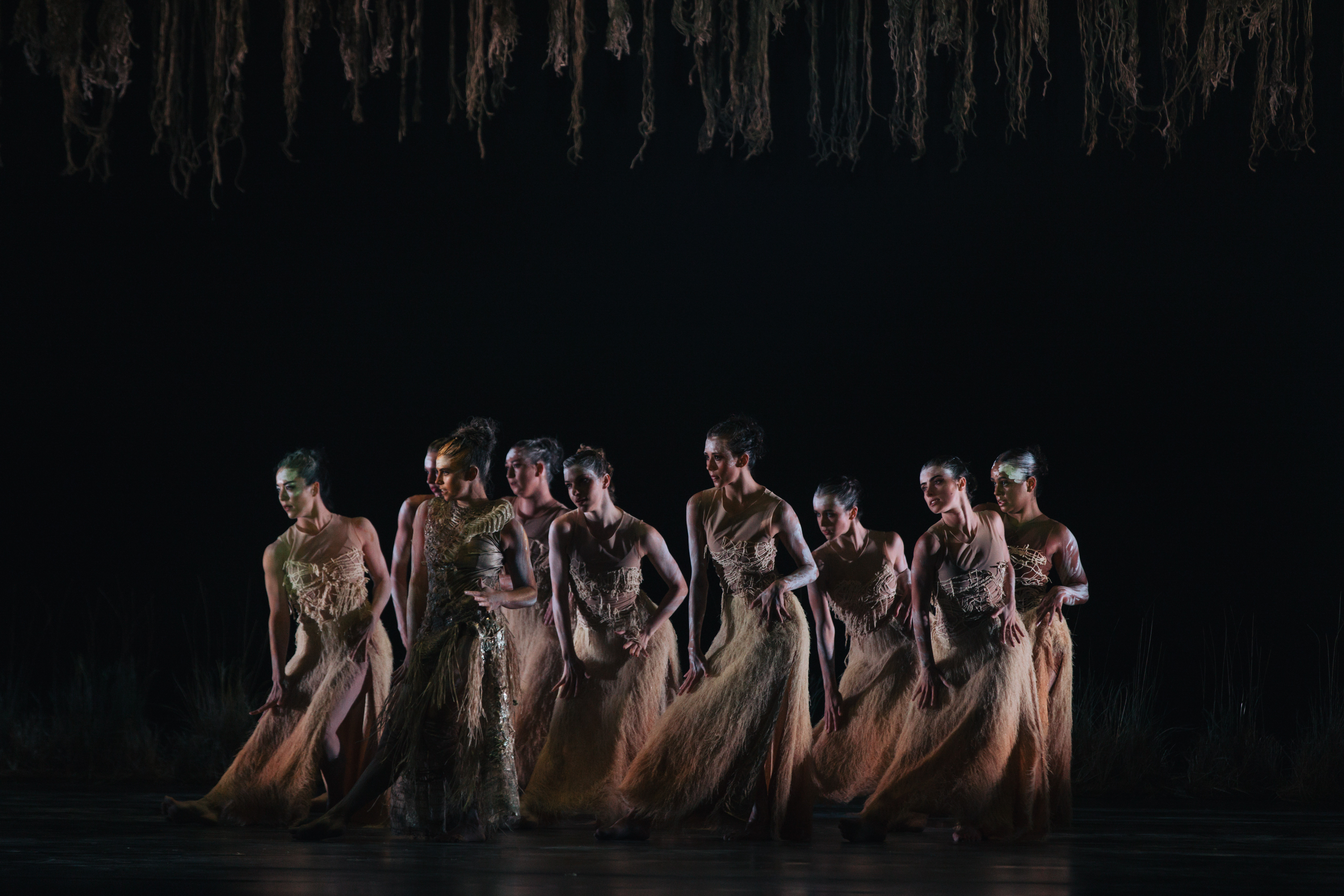
There have been several collaborations between TAB and Bangarra over the past 30 years, most notably Stephen Page’s Rites (1997), one of the many, many responses to Stravinsky’s The Rite of Spring. Rites was, however, more joined up than joint, mostly dividing scenes between the two companies. Flora, choreographed by Rings, is quite the opposite. It was hard to tell where Bangarra began and TAB ended. (The Flora cast of 35 is almost evenly divided between the two companies.)
Rings illustrates this togetherness, this powerful united front, with a repeated motif. Again and again dancers are drawn into a tight huddle, sometimes for connection, sometimes for protection, sometimes – as at the very end – for a journey to transcendence.
Flora ranges far and wide. It begins beneath the earth at the start of creation, it shows how everything living is connected, how plant life nurtures and sustains, how colonisation disrupted the natural order and how renewal is still possible.
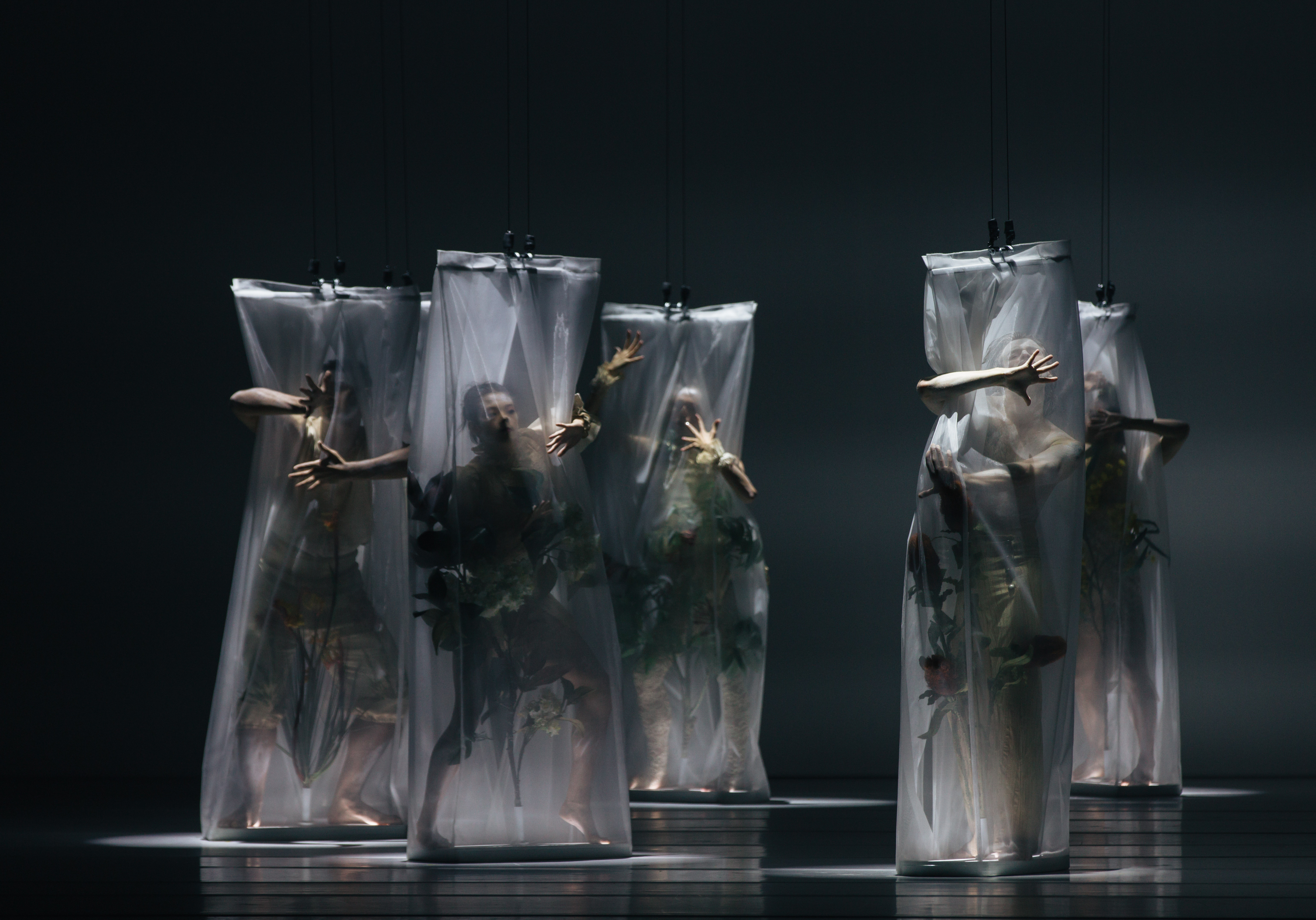
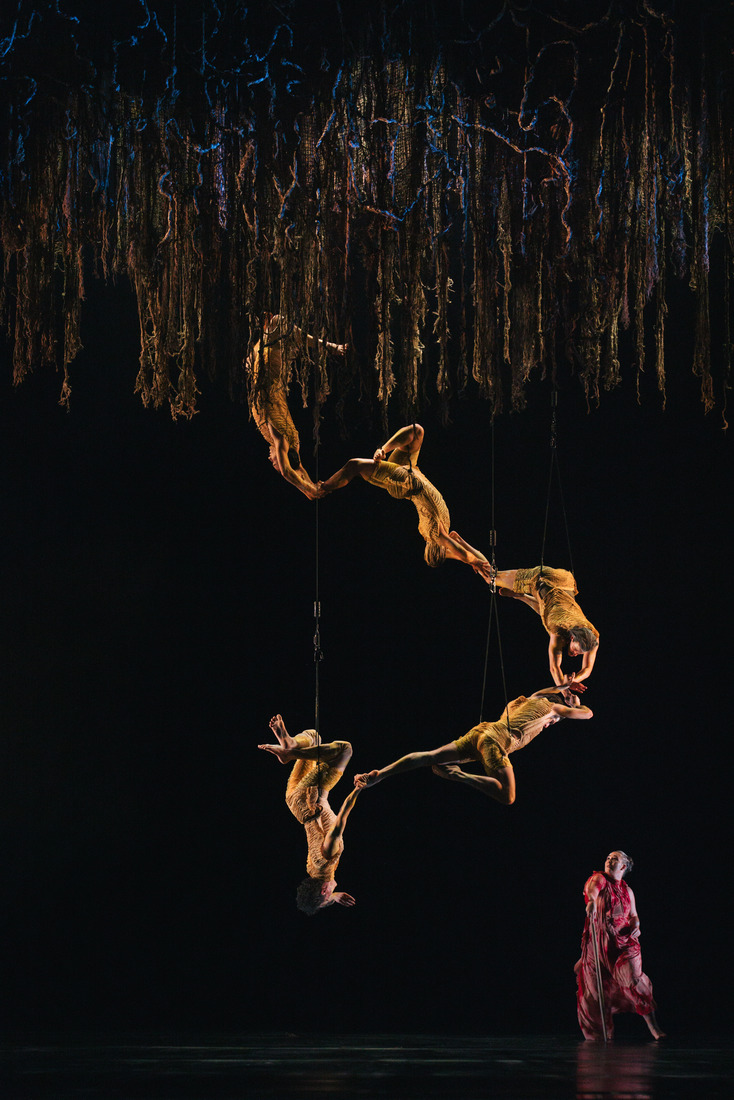
Bangarra is known for its visual poetry so it’s no surprise that Flora is exceptionally beautiful. Each scene is an exquisite moving picture. In an early section a clutch of people – mostly upside down – hangs from a huge arch of root tendrils. They then separate to form a Matisse-like circle and a ravishing curved line. Later dancers are enclosed in individual transparent envelopes, signifying the gathering of plant specimens by Joseph Banks and by extension the despoiling of this unique environment.

Flora is very much an ensemble work but it’s not unfair to single out a small number of soloists: Chantelle Lee Lockhart (Bangarra) and Montana Rubin (TAB) in the striking opening scene Mother Seed; Jill Ogai (TAB) searing in Golden Wattle; Courtney Radford (Bangarra) so searching, passionate and powerful in Bush Flowers. In a solo for TAB principal artist Callum Linnane it was gorgeous to see clearly the luxurious quality of simple single pirouettes and a more relaxed spine and arms. The strong Bangarra stamp of lower-centred, whole-body fluidity had been taken to the ballet.
The lyrical new score by William Barton – one of our greatest cultural treasures – is filled with the most luscious sounds imaginable and includes vocalise from dancers and orchestral players as if they are calling to one another or responding to birdsong in the music. Orchestra Victoria in Melbourne, conducted by TAB music director Jonathan Lo, was cheered to the echo on opening night.
Sliding notes in the brass sound otherworldly as does the occasional eerie whistle (listen for one at the end). Sticks, rattles and bells punctuate lush strings which may be underscored with a grounding low drone or are delicately interrupted by high wind instruments. At the end of the work Barton introduces solemn, ultra-deep thuds that just may be emissaries from the earth’s core.
One or two choreographic moments register less powerfully than others but Rings is at the top of her game with the wild, ritualistic Mother Seed, the charismatic spinifex Grass Keepers moving to pizzicato low strings, stylised depictions of colonial interference in the time-honoured way of things and the custom of using fire to renew the land.
The show looks wonderful at every point, thanks to the creative team’s formidable group of women. Flora’s exquisite costumes by Grace Lillian Lee and associate Jennifer Irwin opulently interpret bush colours and textures, Elizabeth Gadsby designed the eloquent set and Karen Norris the magisterial lighting.
This abundance of female energy fruitfully serves a work about life and the future. Rings leaves the audience with a glorious image of growth and more than a smidgeon of hope.
Sydney to April 18. A version of this review first appeared in The Australian.
 deborah jones: FollowSpot