It’s all change at Queensland Ballet. Again. The company is far from being the only arts organisation experiencing some turmoil – here’s looking at you, Opera Australia – but every company’s woes are its own.
These are interesting times as QB continues to regroup after the retirement of transformational artistic director Li Cunxin. Li left due to ill health at the end of 2023; his successor, Leanne Benjamin, lasted six months.
It’s all about the money. Before his retirement Li had made it clear QB needed more funding and that he was unhappy with the Federal Government’s input. Nothing has changed yet and money was at the heart of Benjamin’s precipitate departure when QB said it couldn’t afford her vision.
New artistic director, the Spanish-born Ivan Gil-Ortega, is taking a more pragmatic approach. In a recent interview in The Courier Mail’s QWeekend magazine Gil-Ortega referred to financial constraints, saying there was “no point” in going over budget and that one couldn’t always have everything one wanted. He is currently preparing the 2026 program, having inherited 2025.
He will, however, as all new artistic directors do, have his view on what the company should look like given the resources he has.
Kenneth MacMillan’s Romeo & Juliet, the company’s first production of the 2025 season, gave Gil-Ortega a close look at the current QB dancers. He will have seen a company in need of some rebuilding (I saw two of the four casts).
R&J is a huge, top-of-the-line ballet. In my review that appeared in The Australian on March 25 I put it like this:
IT takes only four words to sum up Romeo & Juliet: us against the world.
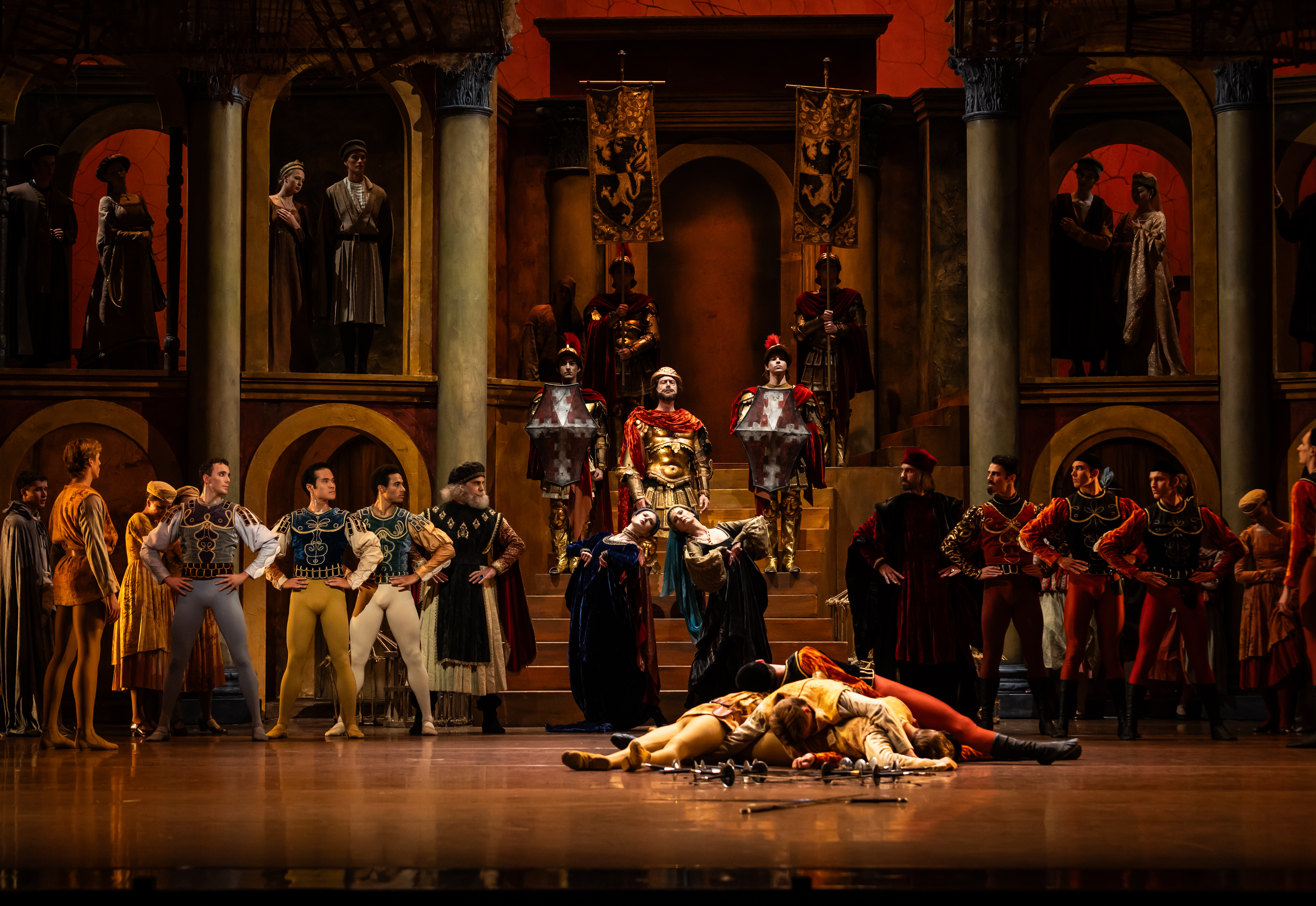
Kenneth MacMillan’s version of Shakespeare’s tragedy shows a world seething with tensions. Two important families constantly niggle each other. Women push and shove and hot-headed men get into deadly sword fights in the street. A somewhat ineffectual aristocrat tries to enforce order but you can see it’s a lost cause.
The swirl of daily activity in a busy, edgy medieval city establishes the public face of Verona. The pomp of a ball given by Juliet’s father, Lord Capulet, shows a more private side. We’ve already seen milord’s iron-clad control over his family. Next comes a display of virile male authority in the Dance of the Knights, driven by Prokofiev’s thrillingly pulsating music.

Wrapped inside that show of power is Romeo and Juliet’s meeting. The young man from one family and a younger girl from the other come face to face and everything goes still. They stand staring at each other for what seems an eternity. Then they dance.
The ballet has to have a transcendent pair of star-crossed lovers at its core but the rub is that those two alone can’t carry the day. The tragedy emerges from the way this society works. Every single role, no matter how small, is a necessary thread in the tapestry.
QB first performed Romeo & Juliet in 2014 with visiting superstars. It was revived well in 2019 with QB dancers only but going by Saturday night’s performance QB isn’t at the top of its game at the moment. It needs to be for this difficult, demanding ballet.
The sense of diminishment came from nothing exactly wrong, but rather an accumulation of small things in the ensemble and secondary roles. Juliet’s oppressive father, for instance, has more weight when played by an experienced man no longer young enough to be a company member. Just the way he treads the ground is important.
The sword-fighting was dextrous enough but lacked heart-in-mouth danger. Interactions between townsfolk were short of clarity. It all adds up.
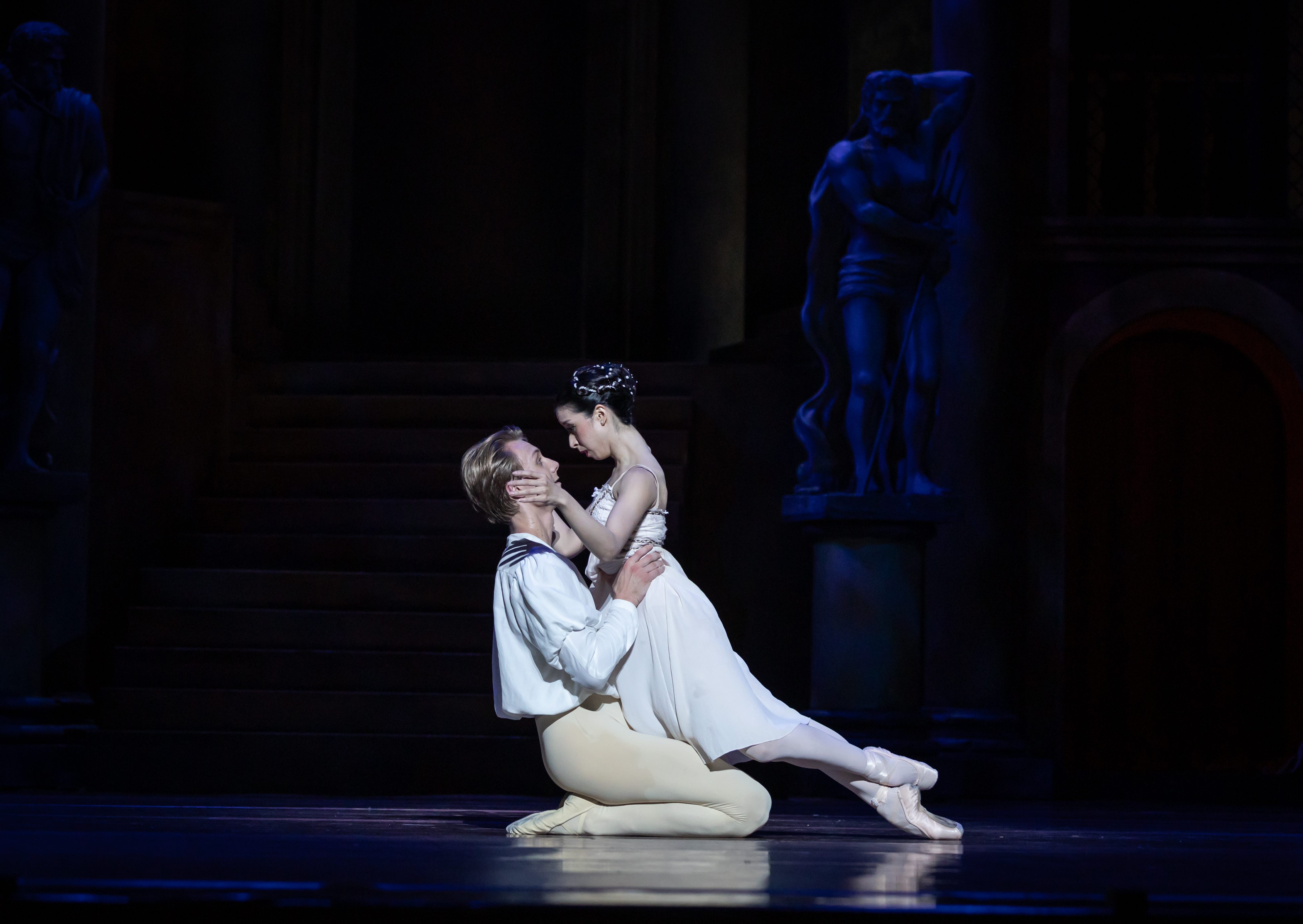
Fortunately the drama on Saturday night was expressively detailed at the centre. Light, fleet Neneka Yoshida embodied the swept-away quality of Juliet’s journey from childish innocence to rapturous first love and then deep despair. Edison Manuel’s Romeo had fresh, boy-next-door charm (Manuel is just 22) and his rapport with Yoshida was a thing of beauty.
Both were making role debuts. Manuel, a company artist (that’s the lowest rung), took a moment or two to find his bearings but settled to prove himself an attractive, responsive actor and secure partner. One of the joys of principal artist Yoshida’s Juliet was to see her great growth as an artist.
If they didn’t have that last bit of abandon that defines the balcony pas de deux, they were entirely invested in MacMillan’s brutal last dance for the pair.
Romeo thinks Juliet dead and frantically tries to insist she is alive, throwing her limp body this way and that before taking his own life.
Not at all pretty, no, but devastating.

I RETURNED to the Lyric Theatre four days after that performance to see guest artists Akane Takada and Australian-born Calvin Richardson, both principal artists with the Royal Ballet, take the title roles. They danced in higher definition, as if the lights shone a little more brightly on them than on those around them. The freedom and intensity of their balcony pas deux was transfixing. Everything seemed the inspiration of the moment. Takane’s Juliet was bright-eyed and inquisitive. She had mettle. Richardson had a touch of theatricality about him; a young man who knew, or thought he did, what he wanted from the world.
It was interesting to hear the Queensland Symphony Orchestra, conducted by QB’s music director Nigel Gaynor, take it up a notch for the Takada/Richardson performance. The music sounded thrilling. It was also fruitful to see illustrious former dancers in the key roles of Lady Capulet (Lisa Pavane), Lord Capulet (Matthew Lawrence) and Nurse (Janette Mulligan). It all adds up.
QB principal artist Patricio Revé was super-luxury casting as Paris in this cast (he was opening-night Romeo, a role he first danced in 2019). Paris and Juliet have an important early dance together so the red carpet was clearly being laid down for Takada.
Revé’s double duty, however, did show up the thinness in QB’s upper ranks. Where in recent years there were seven principal artists there are now five, and of that five, for various reasons only two appeared in Romeo & Juliet.
QB isn’t a small company (the number hovers around 60 if you include the Young Artists) but is particularly bottom-heavy. There are five ranks; six if you count the 12 Young Artists. The top three ranks – principal, senior soloist, soloist – together account for only 12 dancers.
Of course a situation such as this means opportunities for the up-and-comers. In R&J that gave the audience Edison Manuel’s Romeo; first company artist Ivan Surodeev who was Mercutio in the Takada/Richardson cast and danced Romeo to first company artist Libby-Rose Niederer’s Juliet; company artist Clayton Forsyth as Tybalt in the Takada/Richardson cast; and so on.
But these are all relatively unseasoned artists sent out to do an extremely big job. The ones I saw gave intelligent, committed performances. This ballet asks for that and much more.
 deborah jones: FollowSpot
Hi Deborah, Thanks for sharing this ~ I don’t subscribe to The Australian so was disappointed I couldn’t access your review. I went to opening night and it was my first time seeing this production. My takeaway was those magical pas de deuxs with the rest of it, a beautiful gift wrap around them. I wasn’t sure if that was the commonly held response, or other reasons so it was so interesting to read your thoughts. We met at Thomas Dixon Centre a few months ago ~ do let me know if you’re in town ever and would like a chat. I’m still Chairing Ausdance QLD which keeps me busy in an outsized way 😉 Isn’t that every non profit board member’s experience! I’m away all of April in Germany/UK seeing my kids. I feel SO lucky to be seeing the premiere of Bayerisches Staatsballet’s ballet week — Pina Bausch’s Sacre, Kylian, and Cherkaoui. My son’s girlfriend is in it and he is joining Bayerisches next season! Then I’ll see my son premiere Paris in Maillot’s R&J in Karlsruhe. So many lovely ballet treats 🙂 By the way, I reached out to my friend Carla Escoda who writes for Bachtrack and mentioned I met you. She said she always really appreciated reading your work. Anyhow, have a great Sunday, and maybe see you sometime in 2025 here in Brisbane! Best, Anne. Anne Metcalfe | she/her+61 483 180 395
Yes, of course I remember our meeting. It would be great to catch up after your trip – sounds sensational. The Bausch Sacre is the best of the best, and the Maillot R&J so interesting. You should have a spectacular time. I’ll be away most of May but certainly back for the Prelocaj Lac so perhaps then? I will be in Brisbane for a couple of days this time so let’s be in touch.
Macmillan’s Romeo & Juliet has a long history of extraordinary dancers performing the main roles, in particular the Royal Ballet’s Lynn Seymour with Christopher Gable (1965), Fonteyn and Nureyev, Darcy Bussell with Zoltan Solymosi, Sibley & Dowell, Seymour and David Wall (1975) with the latter Clement Crisp exclaims Seymour’s experience (then in her 30s): “in the power to embody emotion and communicate it fully; in musicality … in which the dancer is metamorphosed and becomes the character she dances.” Eleven years on from her 1965 portrayal of Juliet, Crisp continues she, “transcended even her own exceptional past performances of the role”. The premise here is the undervalued quality of ‘life experience’. So many young dancers are expected to have such qualities and only time can imbue these and the artistry that grows with maturity.
Very, very true Sonia. And let’s think of Alessandra Ferri dancing Juliet, by all accounts divinely, in her 50s.
Yes indeed. What an incredible artist!