Tradition reigns in The Australian Ballet’s new Swan Lake, based on a fondly remembered 1977 production by former artistic director Anne Woolliams. Nearly 50 years on it’s still recognisable as her work, albeit with lashings of 21st-century glamour.
Swan Lake is the main event in artistic director David Hallberg’s celebration of the company’s 60th anniversary and in what might even be called a radical choice these days, he decided on a completely conventional production.
Don’t look for contemporary resonances. There’s no psychological inquiry into characters; no veil of social, historical or political events laid over this dark fairy tale. A woman turned into a swan is just that and it’s perfectly reasonable that a prince would fall in love with her. A sorcerer is a sorcerer. There’s even a jester.

In what has been called a reimagining (directed by Hallberg), the body of Woolliams’s ballet is pretty much the same, just dressed in opulent new clothing. “Balancing past and future,” is how Hallberg described it in a curtain speech before the premiere in Melbourne on September 19.
In between past and future is the present – the present TAB dancers in particular. As much as this Swan Lake is for the audience (and, if you’ll forgive the use of this verb, people are flocking to it), it’s to give dancers in the company today a crack at one of the pinnacles of the art form.
The company takes Swan Lake to four cities – Melbourne, Adelaide, Brisbane and Sydney – during this celebratory season. There will be close to 60 performances in all if you include the dress rehearsals. Plenty of opportunity, then, for dancers who are up for the challenge. I saw the first three performances in Melbourne and was rewarded with three very different interpretations of the dual role of Odette/Odile from three principal women. Only one of the Siegfrieds, principal artist Joseph Caley, was experienced in the role. The other two were plucked from the company’s lowest ranks – Misha Barkidjija is a coryphée and Maxim Zenin in the corps de ballet.
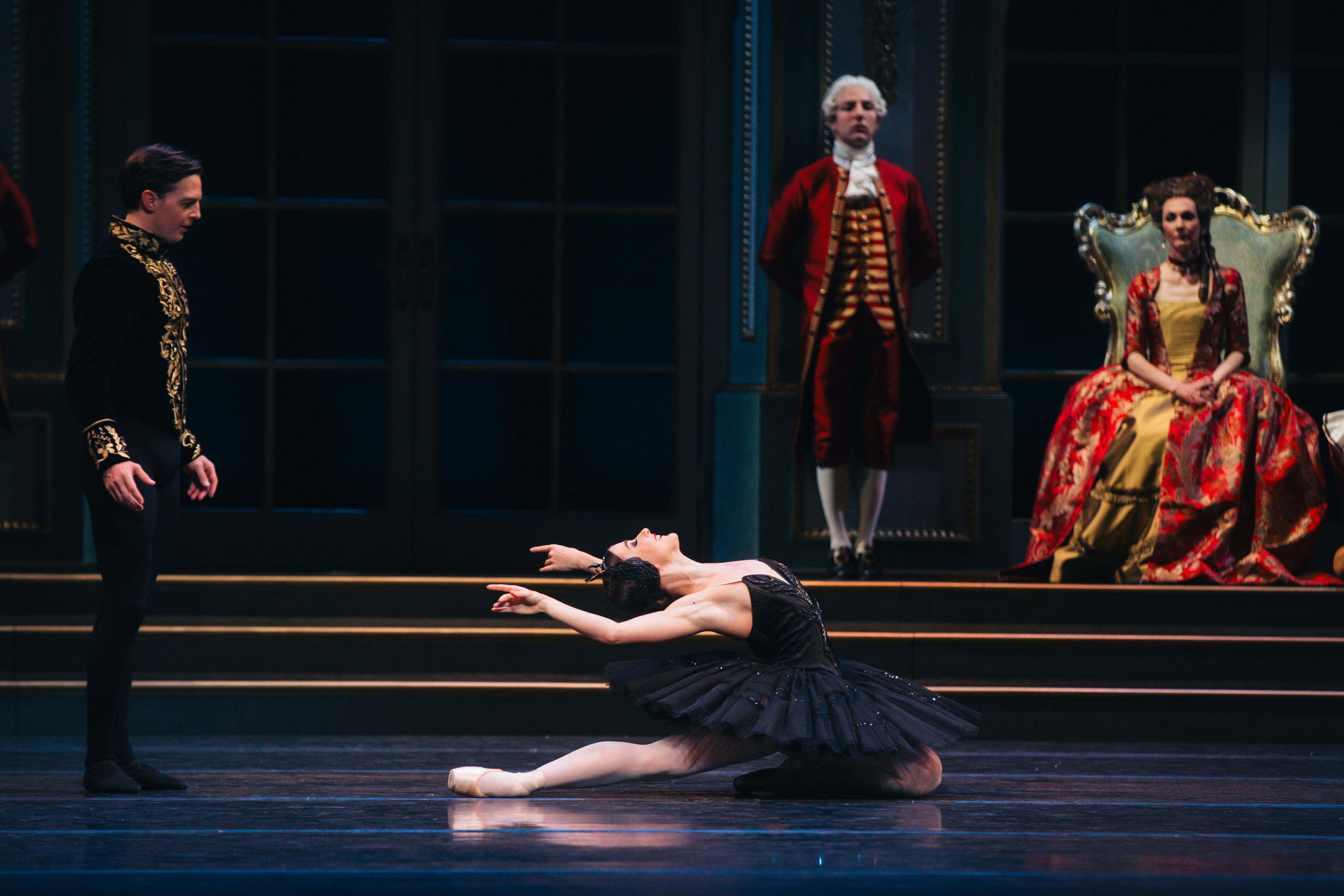
Benedicte Bemet (September 19 with Caley) shone with hope as Odette, a dewy innocent with creamy pirouettes and ravishing balances on pointe that made her seem perpetually on the cusp of flight. Her tremendously seductive Odile was fascinating, Odette to the life but with sharper edges and shrewd calculation. The clarity and detail were exquisite.
Some tweaks to Woolliams’s production include a satisfying expansion of Siegfried’s role in the first act. There and throughout Caley’s open-heartedness and big, joyous dancing were incredibly appealing. He and Bemet are now matched often onstage and it’s a dream partnership.

Hallberg’s faith in Zenin (seen with Robyn Hendricks at the September 20 matinee) and Barkidjija (with Sharni Spencer in the evening of September 20) paid off handsomely. Both men joined the company last year having spent time with the Mariinsky. Both have the pure line and refined bearing of a danseur noble. Both looked wonderful with their ballerina.
Hendricks’s Odette was a broken soul seeking release. Her convulsive anguish in the final act was unforgettable, made perhaps even more tragic because of Zenin’s youth. The truth in his acting was extremely touching. Hendricks tired a little during the rigours of Odile’s fireworks (she’s not long back from maternity leave) but her Odette was searing. Though completely her own woman, she brought back memories of Rachel Rawlins’s Odette in 2012. I wrote at the time of Rawlins: “The torment of Odette’s situation and her desperate need for love’s saving grace have never been more clearly articulated or more moving.” And so for Hendricks more than a decade later.
As it happens, Rawlins is superbly cast as Siegfried’s mother in the Melbourne season of Swan Lake.
Spencer and Barkidjija were a match made in heaven. He has all the technical goods along with personal allure. He looked like a star from the moment of his entrance: relaxed, confident and secure. He partnered intelligently too. Spencer was the Odette to remind you why the woman is called the Swan Queen. She had old-school mystery that made her Odette more dreamlike than the others; more abstract in a way, but very beautiful.
Supporting their queen, the large corps of swans was mesmerising in what might seem the paradoxical task of being a group of individuals acting in tight unison. The occasional loss of focus only brought into greater relief how splendid the women were.
While staying close to the Petita-Ivanov model that’s the source of all traditional Swan Lakes, the Woolliams version has a lovely atmosphere of its own. There’s a human quality that connects audience to stage even when the supernatural is evoked.
The opening of the fourth act, for instance, has the swan corps lying on the ground, connected in sorrow with arms draped over one another as their bodies and arms ripple. The first act’s warmth and liveliness make Prince Siegfried’s outdoor party much more engaging than usual with the sequence of quartets, trios, duets and solos emerging organically from the whole. There’s lovely folk-tinged choreography for the lower orders in which the men looked happily buoyant.
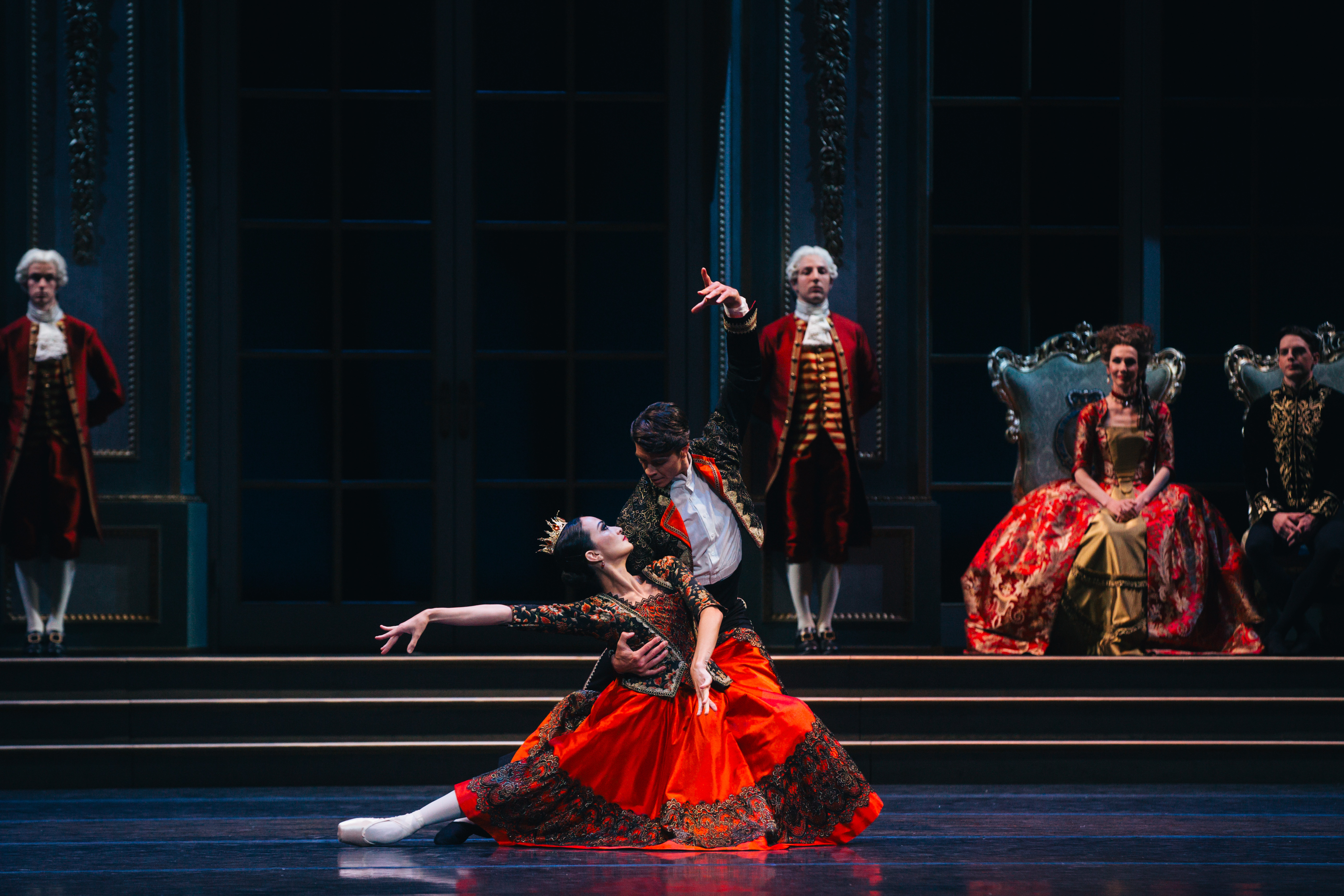
The third act moves at a brisk pace towards the denouement, featuring only three princesses (Hungarian, Spanish, Italian) where most productions will give you four. The shape of the act is undeniably better, as is that of Act IV, which adds a pas de deux for Odette and Siegfried. The drama feels more complete even though the pas de deux is to music by Tchaikovsky that comes from his incidental music for Hamlet and sounds alien in the Swan Lake context. So no, not really orthodox but there’s an emotional payoff worth any quibbling about authenticity – a difficult issue when it comes to one of the most fiddled-with works in the canon.
Swan Lake is set in an elegant way-back-when world with a design by Daniel Ostling that stays tactfully in the background while Mara Blumenfeld’s costumes grab the attention. They are to die for. The swans’ dazzlingly white tutus sparkle as if still carrying drops of water from the lake. The leading women in Act I glow in swagged frocks made of the prettiest colours and Siegfried’s gold-embossed black outfit for the third-act party is divine, as is the Spanish princess’s dramatic red gown.
Hallberg as director, aided by Lucas Jervies as dramaturg, has tweaked Woolliams’s production here and there, mostly to the good. Siegfried has a bigger role in the first act and it was a relief to see Woolliams’s jester quotient halved. The naff choreography was toned down and the remaining jester less irritating, particularly in the hands of Marcus Morelli (September 19) and Cameron Holmes (September 20, evening).
It’s a shame von Rothbart was left such an underwritten character. Only Jarryd Madden (September 19) managed to impose himself as the driving force of the drama. He was rather terrifyingly attractive in Act III in Blumenfeld’s striped suit.
Hallberg hopes this Swan Lake will last as long or longer than Woolliams’s did (that was 20 years). If so, there’s time to sort out a few infelicities, including the ending. The ballet’s final moments are described in different ways, oddly, in the synopsis given in the printed program and the one on the TAB website. Sadly the version that found its way onstage is anti-climactic and, frankly, makes little to no sense.
Fortunately the opposite was the case for Orchestra Victoria with TAB music director Jonathan Lo at the helm. Opening night heard a bold, dynamic reading of Tchaikovsky’s score. It was marvellous to hear so many fresh details emerge from such well-known music.
Everything old was new again.
Melbourne until September 30; Adelaide, October 7-14; Brisbane, October 24-28; Sydney, December 1-20. Livestream available September 29-October 13.
Parts of this review first appeared in The Australian on September 21.
 deborah jones: FollowSpot