I was lucky enough to be in New York in 2015 when Justin Peck’s new one-act ballet, Rodeo: Four Dance Episodes, to the music of Aaron Copland, premiered at New York City Ballet. It was such a rush: a piece for 15 men and one fabulous woman that was an abstract ballet packed with ideas, relationships and really zingy choreography. The men wore striped tops that had the whiff of the football field about them.
That ballet is now the first section of Copland Dance Episodes (2023) which in its entirety – about 75 minutes – is an abstract ballet packed with glamour, wit, glimpses of relationships and really zingy choreography.
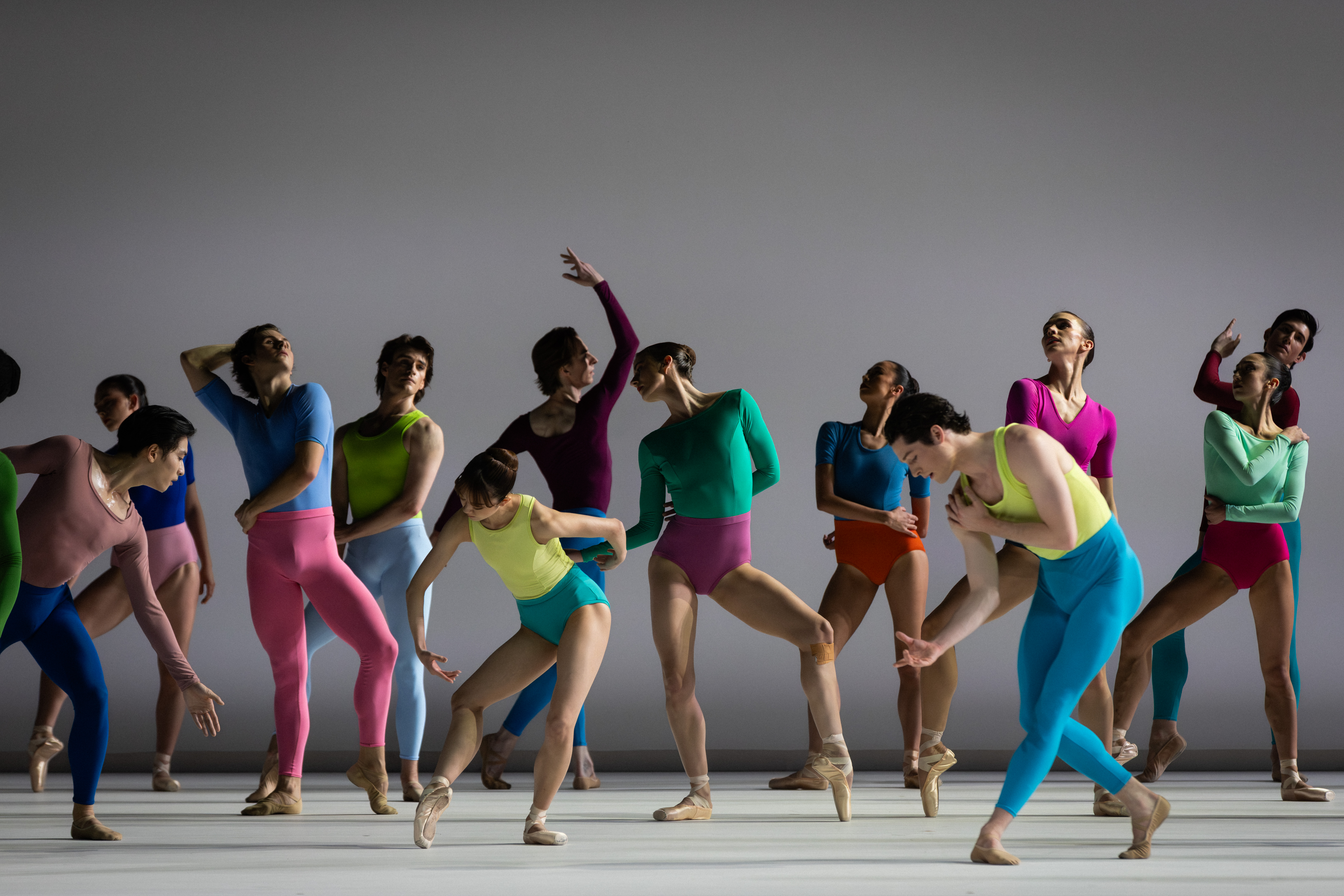
It has many fine slow sections but nevertheless the take-away impression is of speed. The athleticism is galvanising.
When adding to Rodeo, Peck chose Copland’s music for Appalachian Spring, which was written for Martha Graham’s 1944 ballet of that name, and his score for Eugene Loring’s dance work Billy the Kid (1938). Rodeo, choreographed by Agnes De Mille, was made in 1942.
Copland, whose life spanned the 20th century, “had developed a style which, in its incorporation of various folk materials, was as American as plains and mountains and prairies, cowboys and mountain folk, yet in its informed skill was compositionally sophisticated and artistically tasteful”, explained a Los Angeles Philharmonic program note in 1967. I asked Australian composer, broadcaster and writer Andrew Ford what he thought and he said: “This gay, Jewish composer in Brooklyn pretty much invented cowboy music. Hymn tunes and square dances, modal harmonies and syncopated rhythms. And the music suited dance …”
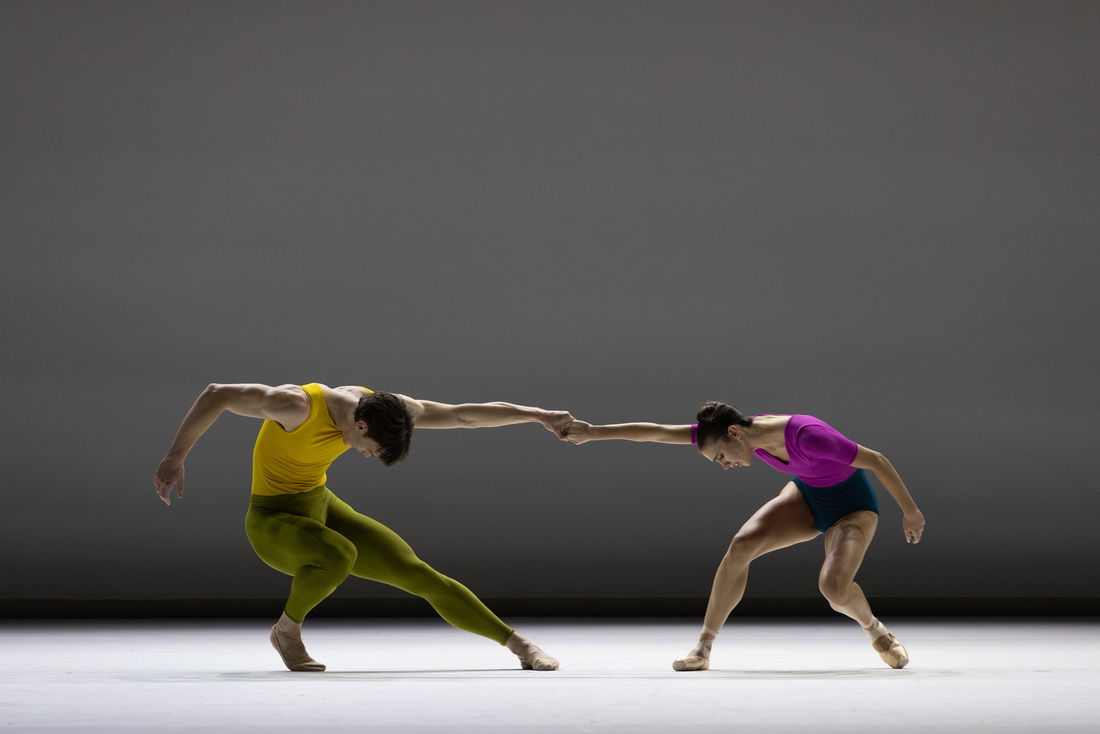
All those influences tease the ear but are not made visible in Copland Dance Episodes except for a flicker here and there. The Shaker song Simple Gifts may wend its way through the score for Appalachian Spring and evoke spaciousness and lack of pretension but it accompanies sophisticated dance that has nothing to do with the hard-working 19th-century pioneers of Graham’s ballet. Well, apart from a strong sense of community that imbues Peck’s dance too.

Copland Dance Episodes also has a musical prologue featuring Copland’s thrilling Fanfare for the Common Man (1943), played as the audience’s attention is drawn to an almost overwhelming front cloth by American artist Jeffrey Gibson, a man of Choctaw and Cherokee lineage. His forebears would not have welcomed the newcomers. A point being made?
Gibson’s cloth pulsates with colours and shapes. A circle made of circles is surrounded by a tight pack of triangles. Movement meets stillness in a riot of blow-your-head-off shades: yellow, orange, green, pink, grey, tangerine, mauve, pale blue. It’s a powerful statement of presence, backed by words – hard to see, but they are there – running up each side of the cloth. “The only way out is through.” You’ve possibly come across this statement before. It is much used, albeit slightly altered from its source, Robert Frost’s 1914 poem A Servant to Servants. People leaped upon these few words in a long dramatic monologue: “I can see no way out but through -/Leastways for me”. The work is worth seeking out.
That background made Copland Dance Episodes more piquant for me, although it must be stressed it doesn’t have to be known to an Australian audience, the first outside the US to see this work. The vital essence of the dance shines through and suits The Australian Ballet admirably.
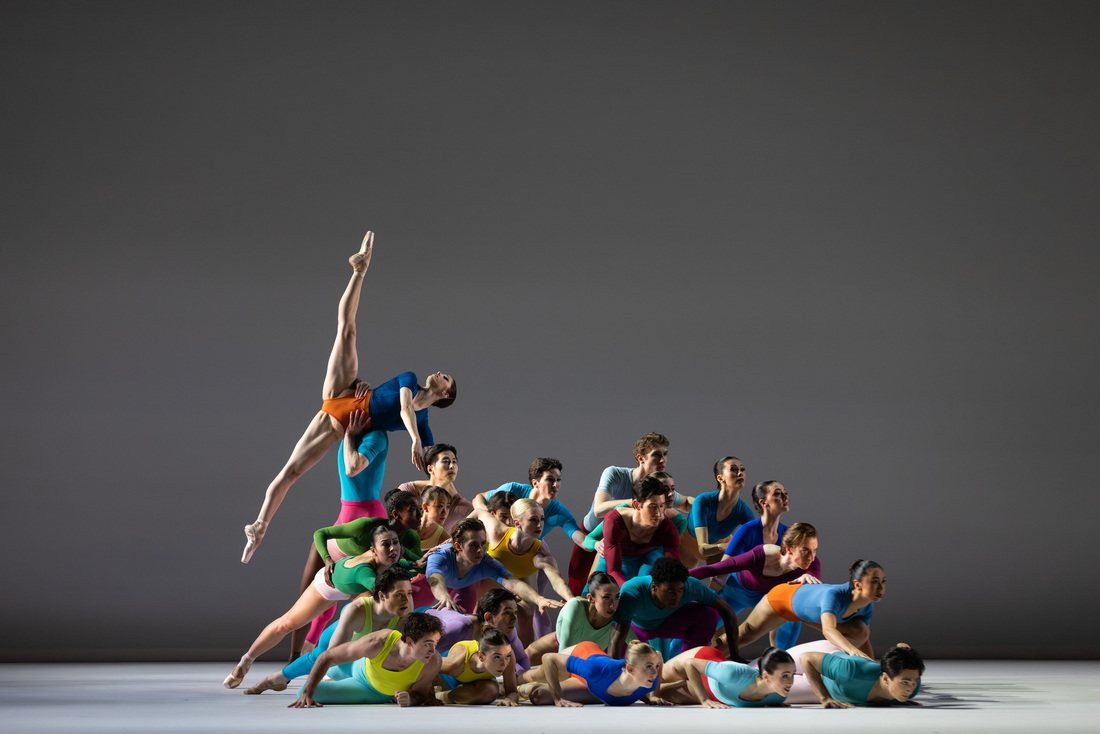
Ellen Warren’s striking costume design of sleek tops and bottoms in block colours takes its cue from Gibson. All in the 30-strong cast are dressed the same, but not. Colour combinations are different for everyone, sometimes dramatically, sometimes slightly.
With such streamlined outfits and no plot to offer cover, individual dancers and their qualities can be seen more clearly than usual, which adds its own interest. They meet, part, get happy, whimsical or a bit sad. They look out for one another. Whatever they make you feel is the story. (One of the feelings is that you want to keep your eyes on newly minted senior artist Samara Merrick and recently elevated soloist Elijah Trevitt as both ascend the rankings ladder.)
The stage itself is bare and white. Lighting (design by Brandon Stirling Baker, relit by Jon Buswell) brings some changes in atmospherics but the core business is bodies in motion, dancing to great 20th-century ballet scores repurposed for the 21st century. TAB’s music director and chief conductor Jonathan Lo was at the helm of Orchestra Victoria (in June at The Regent) and then the Opera Australia Orchestra (Sydney Opera House) at the three performances I saw. Terrifically engaging music that’s rarely heard here was illuminated.
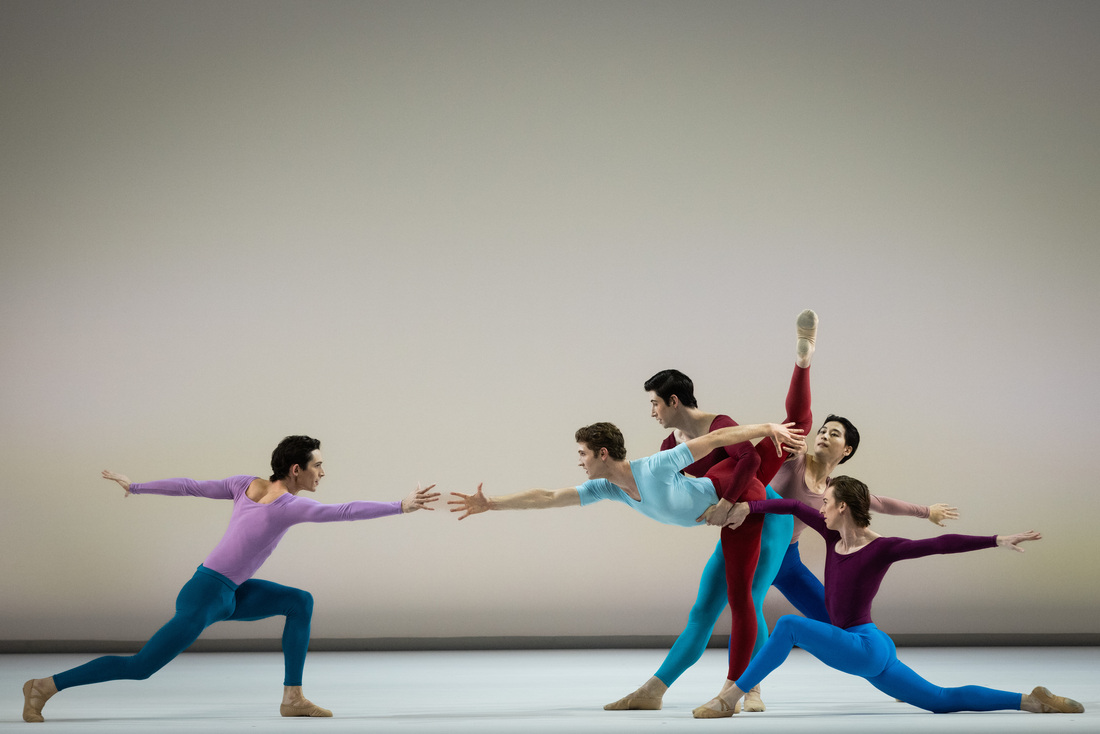
In Peck’s world the group’s the thing. He opens with a static image of the ensemble and ends by scattering it. In between there’s an unbroken stream of encounters in all sorts of permutations and repetitions. A trio seen in Rodeo forms and reforms elsewhere, as does a lovely, restrained but emotionally rich all-male quintet. Five women in Appalachian Springhave their own get-together and so on.
The structure is just tight enough to bind everything but still has attractive moments of freedom, epitomised by how dancers stand in repose. Their arms look relaxed and the stance is more off-duty than barre-ready. Also delightful to see is Peck’s democratic way with partnering. Men may partner men and women may partner women. Or we could just say people partner people.
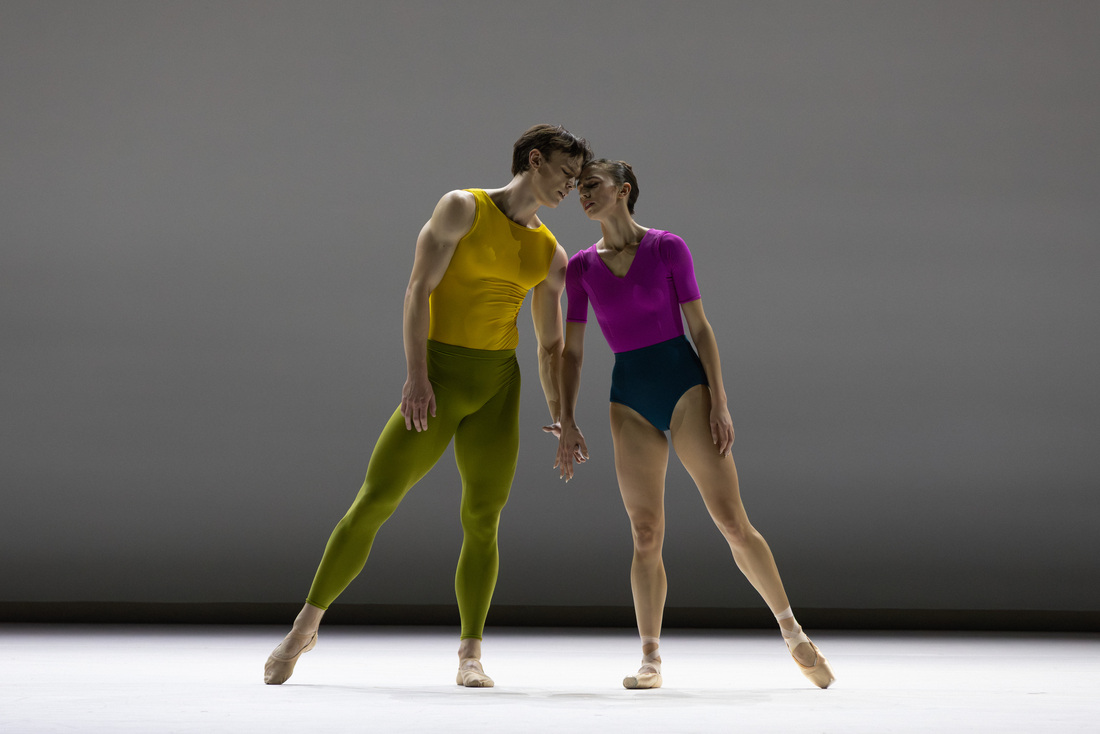
Mix and match is the name of the game in casting, no matter the dancer’s rank. On opening night in Sydney (as in Melbourne), senior artist Isobelle Dashwood put in a blinder with Jeremy Hargreaves, a member of the corps de ballet, as a couple weaving its way through the ballet trailing fragments of personal history.
Dashwood and Hargreaves are imposingly tall (Hargreaves is able to look Dashwood straight in the eye when she’s on pointe) and both extracted full value from Peck’s super-stretchy choreography.
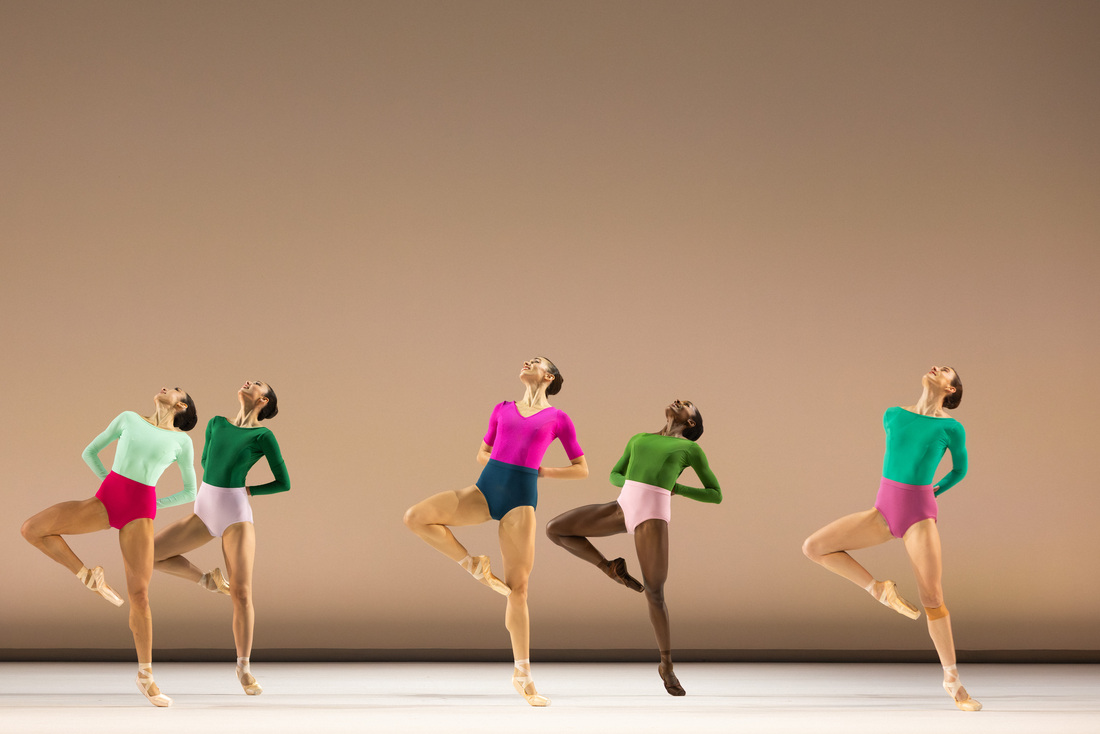
Senior artist Precious Adams, who joined the company this year from English National Ballet, was fruitfully partnered in Sydney with TAB’s newest principal artist Davi Ramos in these roles. They were a joy to see, marrying exquisitely refined classical technique and innate elegance with heart-tugging, understated sweetness. Unfortunately there are no images of them in the roles but Adams was in the women’s quintet, as you see above.
Copland Dance Episodes mostly lets gestures simply be themselves rather than an aspect of a continuing narrative but it’s impossible not to start making up stories oneself. If parting seemed inevitable in the melancholy-tinged duo of Dashwood and Hargreaves, one was sorry to see Adams and Ramos go their separate ways. I look forward to seeing Adams in prominent roles next year.
Copland Dance Episodes ends in Sydney on November 21.

