Stuttgart Ballet’s appearance in Melbourne comes thanks to The Australian Ballet, under whose banner Stuttgart’s Sleeping Beauty is being performed while TAB is tied up with its tour to the United States with Christopher Wheeldon’s Oscar. It’s a delectable gift.
Marcia Haydée, John Cranko’s indispensable muse during his transformative artistic leadership of Stuttgart in the 1960s and early 1970s, created this production in 1987 when she directed the company. Petipa’s ballet is the framework, complete with the expected dance highlights, but Haydée also puts a hugely personal stamp on the work.
Not everything is entirely plausible even within the latitude allowed by a fairytale but the overall effect is disarming. This is grand classical ballet presented in the traditional manner and yet with a charming degree of modesty, as if it’s an honour to pay tribute to Petipa and the art of ballet.
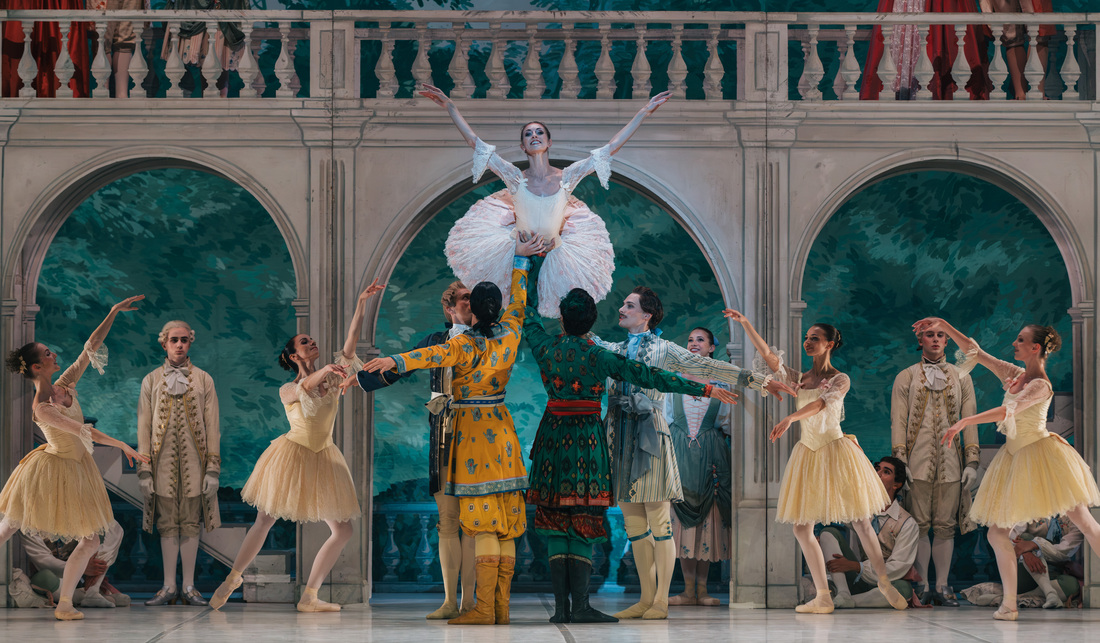
One setting cleverly adjusts as the story unfolds. Jürgen Rose’s design of a delicate, sylvan painted backdrop and arched upper gallery has something of a child’s pop-up book flavour and many of his costumes are muted in tone, although the fairies, who have adorable caps with slender sparkly antennae, and the handsome foreign princes are gorgeously attired. Aurora’s girlfriends in Act I wear tutus that remind one of Degas paintings. They are incredibly flattering.
The curtain rises to show a group of courtiers, all in shades of blue. The atmosphere is one of calm and serenity. The look establishes Haydée’s generous mood for the piece. Nature, love and harmony are her guiding principles.
Haydée greatly expanded the disruptive fairy Carabosse’s role so that the forces of darkness are in constant opposition with those of light in the form of the Lilac Fairy. The scales tip this way and that, just as in life, but it’s clear that while the world will always have to contend with malevolence, good is the higher power.
The most enchanting aspect of the staging is how Haydée introduces a natural sense of community into this highly artificial world. There are so many small moments to cherish. The four princes vying for Aurora’s hand jockey – courteously! – for position and graciously reappear in the wedding scene each had hoped to feature in. That’s good manners for you.
As Aurora makes her entrance you can see her in the background waving excitedly to her friends and in one of the few moments of respite in the Rose Adagio she dashes over to those friends for a quick confab. One almost expected a little shriek of excitement.
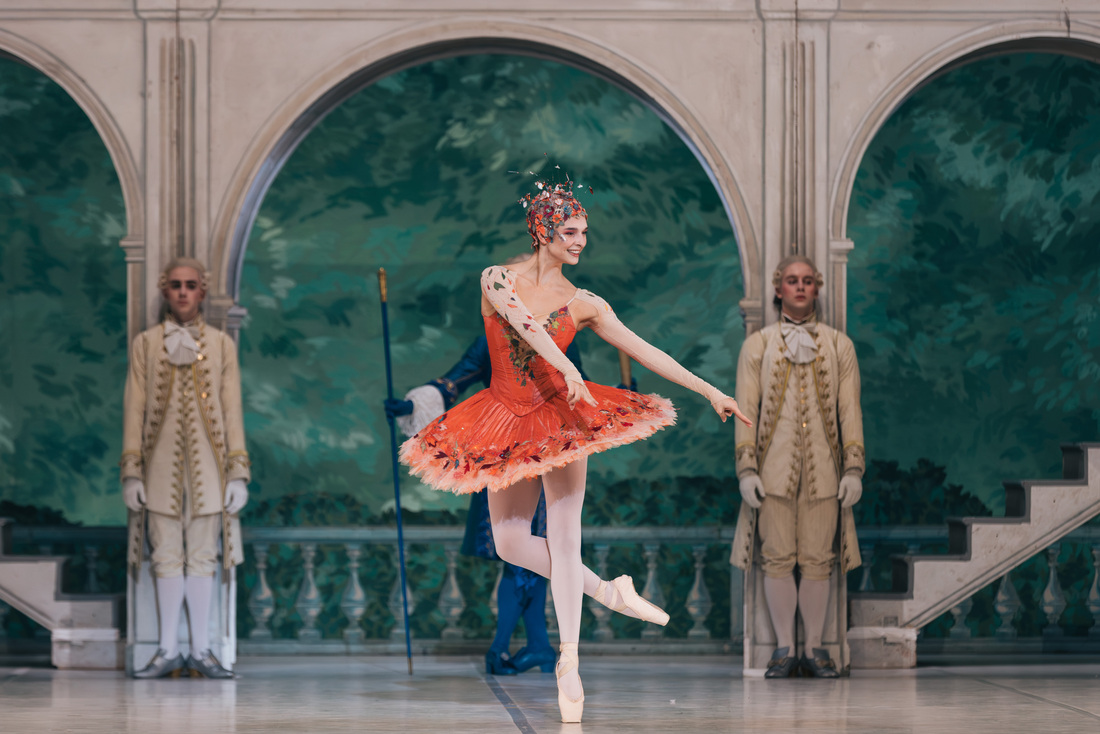
Elisa Badenes was an enchanting Aurora on opening night, light and joy radiating from her as if she were floating on air. (Unfortunately there were no photos of her m are available.) Those fearsome Rose Adagio balances got a rushed job but never mind. The audience absolutely adored her. Abigail Willson-Heisel’s Lilac Fairy, who matched Badenes in the glow of her port de bras, was the epitome of fragrant grace as again and again she magically repelled Jason Reilly’s ultra-forceful Carabosse.
Haydée conceived of this as a role to be danced by a man and gave the character a full suite of bravura moves (Carabosse starts with a bold double tour en l’air and goes on from there). It was interesting to go back to a profile of Haydée published in The Australian in 2010 when West Australian Ballet performed her Sleeping Beauty in Perth. (Haydée knew then-WAB artistic director Ivan Cavallari from his Stuttgart days.)
“I said to Ricky {Richard Cragun, who originated the role], ‘I want Carabosse to be like a Kabuki character, you don’t know if it’s a woman or a man with long hair and black dress. He cannot be like a drag queen; he has to be abstract and dramatic. It’s very technically strong; the first solo in the middle of the prologue brings the house down because it’s a woman doing leaps with the power of a man,” Haydée told The Australian.
Carabosse is therefore outside gender; a shapeshifter. It’s a powerful take on the role, albeit with occasional naff touches, that threatens to overshadow the expected male leading role, that of Prince Desiré. In the first cast Henrik Erikson didn’t impose himself strongly enough on the drama. He’s a lovely classicist and secure partner who nevertheless seemed a little too correct and looked pressed by the end.
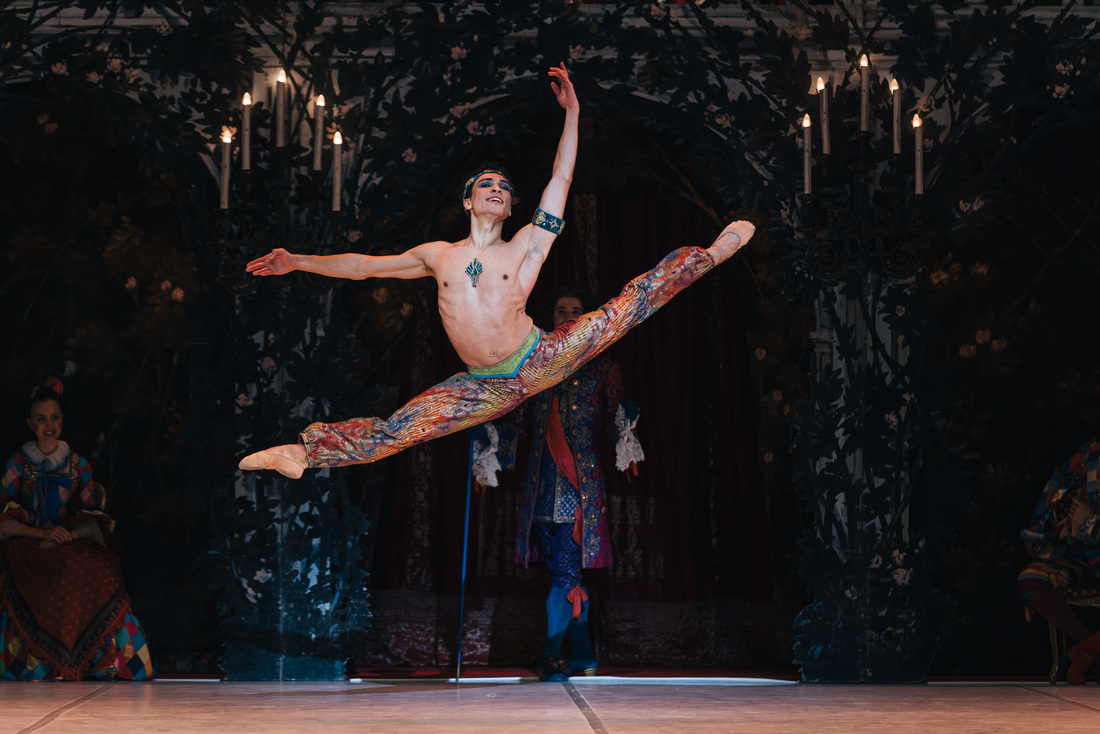
Haydée gives a lot more stage time to the men, a choice that led to some disconnects between choreography and music usually danced by women. This was very much the case in Act III when Ali Baba surprisingly popped up among the plethora of storybook characters at Aurora and Desiré’s wedding. Mind you, no one was complaining on opening night when scorching demi-soloist Riccardo Ferlito, looking as if he were in Le Corsaire, took to the stratosphere to music that wasn’t really right for the choreography but no one cared. Ferlito’s blurringly fast tours en l’air were astonishing and had the audience in raptures. (The photo below is from another cast. On opening night Dorian Plasse danced the Blue Bird.)
Rapture was also the response to the appearance of local dance students as Snow White’s seven dwarves. It was a pity, however, not to see children dancing with garlands in the Act I waltz. A photograph in the program clearly shows that’s the way it’s done in Stuttgart but Melbourne saw a garland-free waltz of reduced impact.
Underpinning it all, Stuttgart Ballet’s music director, Wolfgang Heinz conducted Orchestra Victoria in a plush reading of Tchaikovsky’s magical score. It was greatly satisfying to see the musicality of the Stuttgart dancers given room to breathe and flourish. Both Badenes and Willson-Heisel luxuriated in the music rather than simply danced to it. Irene Yang stood out as the sparky Blue Bird Princess.
There are four lead casts during the season, including Willson-Heisel as Aurora. Take a look on the TAB website for dates.
The Sleeping Beauty is at the Regent Theatre, Melbourne, until October 18.

